
How 1950s America learned to fear the atom, love the appliance, and keep clocking in
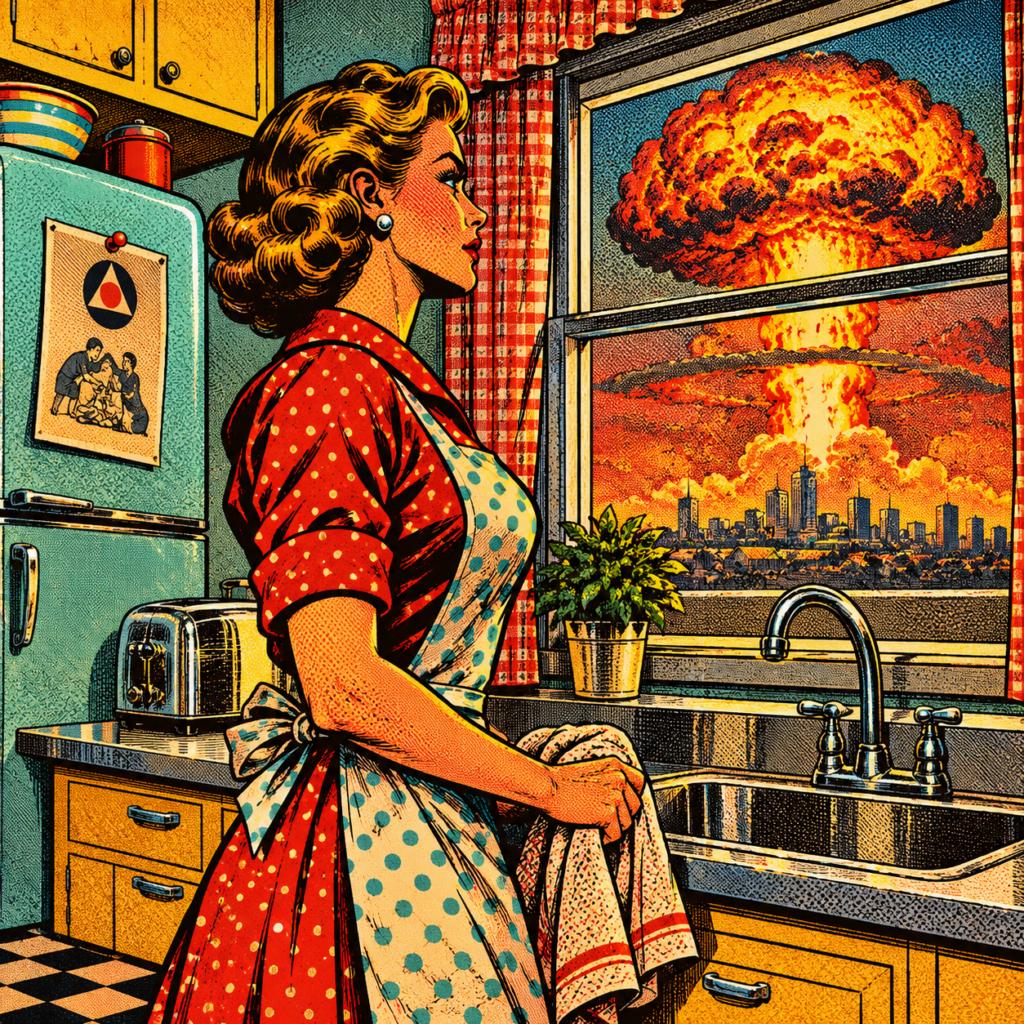
A woman in Westchester is sorting the laundry. Her husband has left for the office in the city, her daughters are at school, and she is wondering whether she can get through the wash before her afternoon errands. Then New York vanishes.
That is the first chapter of Judith Merril’s 1950 novel Shadow on the Hearth, and it is the best summary I know of what the Atomic Age actually was. We picture mushroom clouds over the Nevada desert. But the real blast zone was the kitchen, the classroom, the pulpit and the factory floor. The bomb never fell. It just moved in.
Here are nine documents from that strange decade, read as one story about how a country was taught to live with the end of the world.
The memo that started it all
On 18 August 1945, days after Hiroshima, Saturday Review editor Norman Cousins published an editorial with a title like a diagnosis: “Modern Man Is Obsolete.” His argument was that humanity had upgraded its weapons, its machines and its economy, but never itself. We had become a self-made anachronism.
The essay ran through American public life like a current. Readers from the Supreme Court down praised it. For the next fifteen years nearly everything Americans said about the bomb was, knowingly or not, an answer to Cousins. If man is obsolete, what is a man for? What is work for? What is a home for?
The government moves into your basement
Washington answered with a pamphlet. Survival Under Atomic Attack (1950) was meant to calm people down, and it used the friendly tone of a home-economics manual. Close the blinds. Stock canned goods. Lie flat against a basement wall. A year later, schoolchildren across the country were watching Duck and Cover and practicing under their desks.
It was a brilliant move, and a cynical one. National defense was handed to the household. The father was told to keep working, and the mother became the bunker’s quartermaster, managing water, rations and morale. If your family didn’t survive, the implication went, it was because you hadn’t read the booklet.
The preacher who read the headlines
In September 1949, two days before a young evangelist named Billy Graham opened a tent revival in downtown Los Angeles, President Truman announced the Soviet Union had tested an atomic bomb. Graham didn’t waste the timing. He told his crowds the world faced a stark choice between revival and judgment, and he warned the atomic bomb was of divine judgment.
The Hearst papers picked up the story, the tent kept filling, and modern American evangelicalism went national. In the Atomic Age, fear wasn’t only a political tool. It drove conversions. The bomb gave old-time religion a new deadline.
The friendly atom
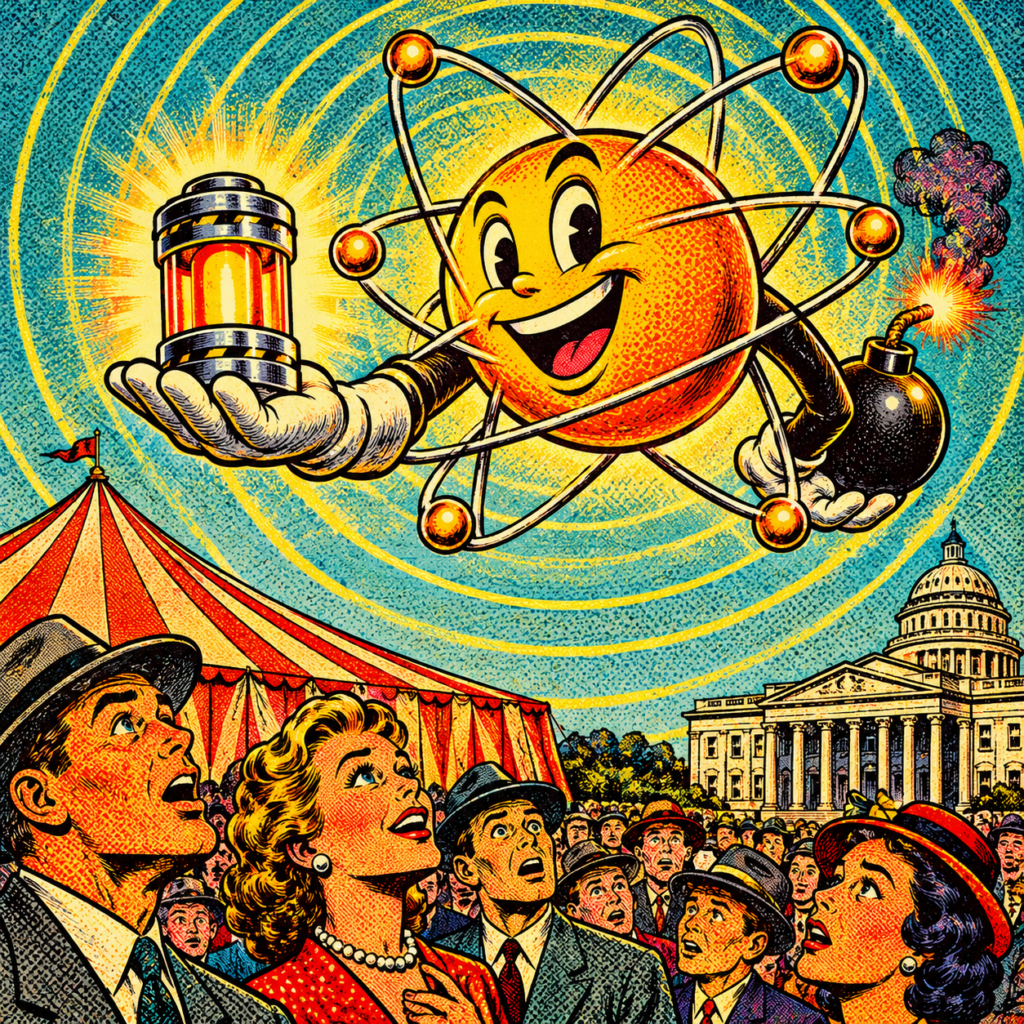
By 1953 hydrogen tests were raising public alarm about fallout, and Eisenhower went to the United Nations with a new product: Atoms for Peace. Reactors would light cities and isotopes would cure disease. The atom was rebranded as a helpful neighbor.
For readers who like their history with a little tinfoil, this is the good part. The paper trail shows the campaign was designed as “emotion management,” balancing nuclear dread against nuclear hope, and Eisenhower himself filed the strategy under psychological warfare. The government wasn’t denying the danger. It was rationing your reaction to it.
The machines want your job
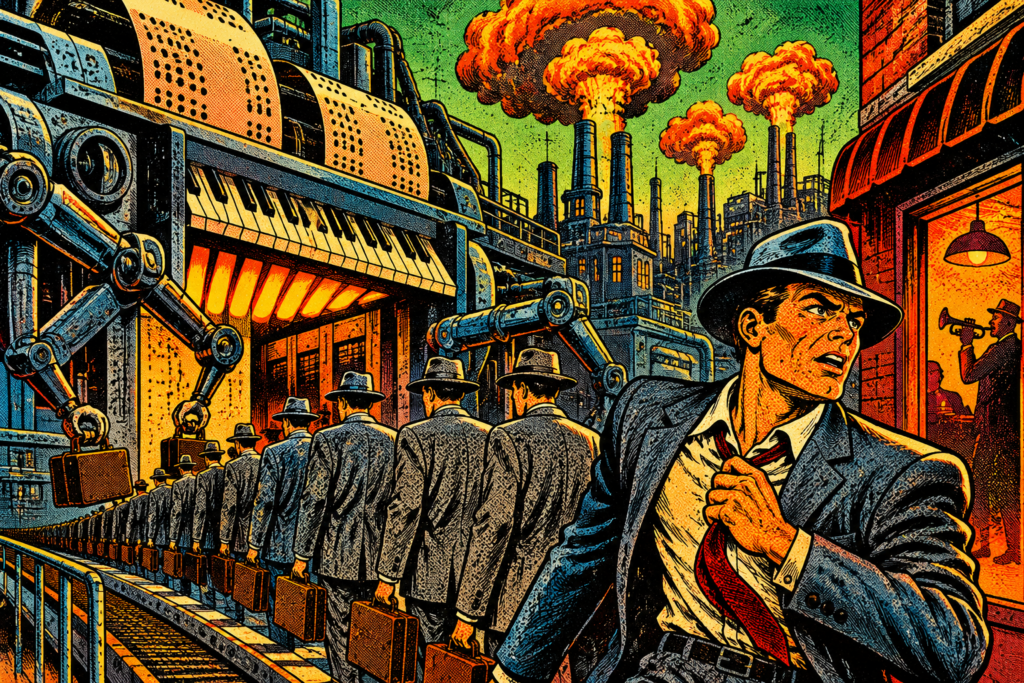
Kurt Vonnegut spent the late 1940s writing publicity for General Electric in Schenectady, where he watched machinists’ movements being recorded so machines could repeat them. He quit, and in 1952 he published Player Piano: a post–World War III America in which managers and engineers run everything and everyone else has been automated out of a purpose.
This is the Atomic Age’s least-discussed fear. The science that split the atom could also split a man from his work, and in the 1950s a man’s work was his identity. Vonnegut saw that losing your job could be its own kind of apocalypse, quieter but just as total.
The kitchen as battlefield
In July 1959, in a model American home at a Moscow trade fair, Vice President Nixon and Premier Khrushchev argued about washing machines. Nixon’s opening point was how much America valued its housewives. Khrushchev scoffed at the gadgets. The networks broadcast the whole thing the next day.
It sounds like satire, but it was the Cold War summed up. American freedom was being sold as a well-equipped kitchen and a paycheck big enough to fill it. The suburban home wasn’t a retreat from the arms race. It was a showroom for it.
The rebels in the basement
Not everyone signed up. In 1957 Norman Mailer published “The White Negro” in Dissent, a manifesto that hit college campuses hard. His hipster faced two ways to die: by atomic war or, more slowly, by conformity. Mailer’s answer was to drop out of the office, the marriage and the mortgage, and live for the moment.
The essay’s racial romanticism has aged badly, and critics said so at the time. But it named something real. For a certain kind of rebel, the bomb wasn’t a reason to hide in the basement. It was a reason to burn down the suburbs, at least metaphorically, along with the whole notion of a sensible life.
The woman holding it together
Back in Westchester, Merril’s housewife is holding the fort. Her husband has disappeared, the civil defense man is smug and unhelpful, and the state is more interested in secrecy than in saving her daughters. Critics at the time dismissed the book as small and domestic. That was the point. Merril understood before almost anyone the Atomic Age would be lived, and survived, by the person doing the laundry.
The decoder ring
In 1988 historian Elaine Tyler May gave all of this a name in Homeward Bound: domestic containment. Just as American foreign policy aimed to contain communism, American culture aimed to contain everything frightening, from the bomb and subversion to sex and women’s independence, inside the nuclear family. Early marriage, big families and the suburban home weren’t just a postwar boom. They were a security strategy.
Read that way, the bomb shelter and the master bedroom were the same room.
The fallout
The paranoia of the 1950s wasn’t really about a weapon, which is why it still feels familiar. It was about a technology that nobody fully understood, sold to the public as both a threat and a miracle, while ordinary people were told to keep calm, keep house and keep working. Swap “atomic” for whatever this year’s frightening technology happens to be, and the pamphlets nearly write themselves.
Cousins was half right. Modern man wasn’t obsolete. He was just very, very busy doing the dishes.


